A First-Time Volunteer Session, Planned in Three Clear Stages
A first-time volunteer session can turn a willing newcomer into a confident helper through a brief orientation, one bounded task and a clear handover.
A first-time volunteer session works best when a newcomer can see what to do, where the work ends and who takes it from there. If you are arranging a neighbourhood clean-up, a community garden morning or a shared-room sorting session, the shape matters as much as the task: welcome people, work alongside them, then hand the result on.
There are several ways to organise that shape. A guided session suits a mixed group and an unfamiliar task; a choice-based session gives people more say; a paired session offers close support for those who would rather begin quietly. Each can follow the same three stages without turning a one-off gathering into a formal programme.
Choose a session shape that matches the work
Start with the nature of the task, not an assumption about what volunteers will enjoy. A bounded task has a visible finish and can be explained in ordinary language: sort donated books into agreed categories, weed a defined garden bed, or prepare a room for a community meal. Work involving specialist tools, hazardous materials or decisions about people’s private information is not suitable for an improvised first-time session.
A guided session keeps everyone on one shared task, with a host demonstrating the agreed approach before the group begins. It is suited to jobs where consistency matters, such as arranging a lending shelf or clearing a particular planting area. The trade-off is that the host needs to remain available rather than disappearing into the work.
A choice-based session offers two or three clearly described tasks, such as preparing labels, sorting clean reusable materials or tidying a seating area. It suits a group with different interests or energy levels, provided every option has its own boundary and a named person to ask. Too many choices can leave newcomers uncertain, so keep the menu short.
A paired session gives each newcomer a companion who knows the place and can explain small decisions as they arise. It suits quieter work or tasks that are easier to learn by watching. This approach depends on having enough confident regulars; pairing should not make one person responsible for answering questions outside their knowledge.
Choose the simplest shape that fits. A jar of seeds is easier to share when each person knows which part belongs to them; a group task benefits from the same clarity. Where the right approach depends on a product label, the organiser’s instructions or local rules, check those before inviting people to take part.
Stage one gives newcomers a clear landing
Keep the orientation short, but make it more than a welcome and a list of names. Point out the meeting place, the accessible route to the work area, the toilet and drinking water. Introduce the host and explain how to ask for help or take a break. A newcomer should be able to arrive without needing to guess whom to approach.
Then state the task in a few concrete details: what the group is doing, which area is included and what counts as finished. Show any materials people will use, such as gloves, labels, buckets or a clipboard, and explain how the group will share them. If the task has an element people may prefer not to handle, offer a different useful role without asking them to explain why.
Say what is outside the task as plainly as what is included. For a garden session, that might mean tending one named bed while leaving the path and other beds untouched. This prevents helpful improvisation from creating extra work for the next group.
Stage two keeps the shared task within bounds
Demonstrate the first small piece of work, then invite volunteers to try it while the host stays nearby. Avoid assigning a large area to each person if the work is meant to be shared; give the group a common endpoint and a way to check progress. A simple board with the task and its boundary can help late arrivals join without interrupting someone for a full explanation.
Make the pace adjustable. Some people may finish one part quickly; others may prefer to observe before joining. A useful host notices when the instructions are unclear, pauses to clarify, and reshapes the task if the original scope proves too broad. The aim is not to keep everyone busy at every moment, but to make participation understandable and worthwhile.
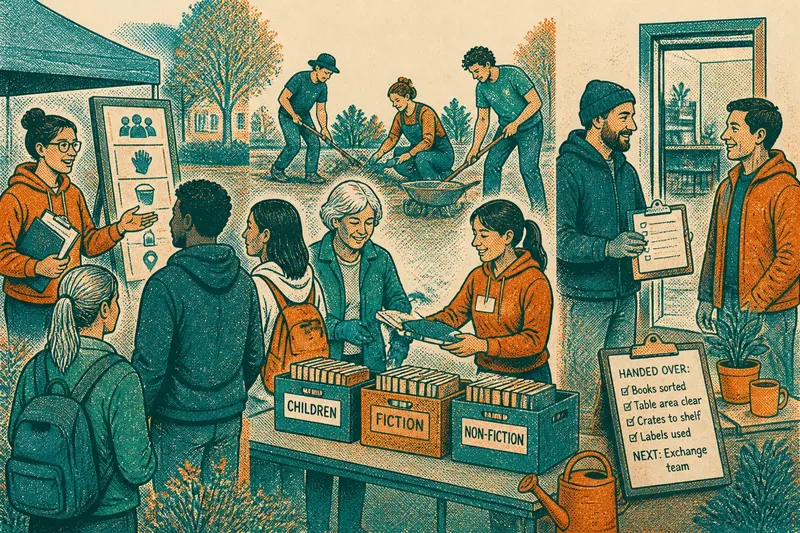
Say you are hosting a session to sort clean books for a neighbourhood exchange. You set out three labelled crates, explain that the group is sorting only the books on one table, and pair newcomers with a regular who can answer questions. When the table is clear, the expected observable result is a sorted set ready for the named handover, rather than a larger collection of half-finished shelves.
Stage three makes the handover part of the work
Allow time to stop, gather materials and look at what is complete. The handover can be a short conversation with the person or group responsible for what happens next: where sorted items go, who will water a tended bed, or which room needs to be returned to its usual arrangement. Name the next action and its recipient; “someone will deal with it” is not a handover.
Record only what the next person needs. A note on a shared clipboard might say which sections are finished, what remains untouched and where the materials have been put. Do not leave a newcomer with an implied obligation to return. If there is another opportunity to help, offer its details as an invitation, not as the missing final step of today’s task.
Close by thanking people for the specific contribution they made and checking whether anyone needs directions back to the exit or transport stop. A calm ending gives newcomers a chance to leave without being caught in an unplanned meeting or asked to commit on the spot.
Which session approach suits your group?
When is a guided session the better choice?
Choose it when everyone needs to follow the same method or produce work that fits together. It is also useful when a newcomer can learn the task quickly from a short demonstration.
When should volunteers be offered a choice?
Offer a small choice when the work naturally separates into independent tasks and people may have different preferences. Make sure each option has a clear boundary and a person available for questions.
What if a newcomer wants to observe first?
Let them watch the demonstration or work beside a host before deciding whether to take on a task. Observation can be a real first contribution when it helps someone understand the setting and join at a comfortable pace.
How can you tell whether the task is too large?
If the group cannot describe what finished looks like, or the handover would require a long account of unfinished work, narrow the scope. A smaller completed task is easier for both newcomers and the next group to understand.
Choose a finish that leaves the next person ready
For a first-time volunteer session, the best option is usually the one whose work can be explained before it begins and handed over without guesswork. Match the format to the task, keep the orientation human and brief, and protect the group from scope creep. That combination gives a newcomer a genuine contribution without making the first visit feel like an unspoken commitment.