Open Room or Booked Slot: Two Ways to Share a Community Space
Open room or booked slot? Compare predictability, flexibility and activity needs to choose a shared-space pattern neighbours can use with confidence.
Open room or booked slot: which arrangement lets neighbours use a shared space without making it feel either empty or over-managed? The answer often depends on what people need to do there, and how much certainty they need before setting out.
A drop-in room stays available during stated open hours, with people coming and going as they please. A booked slot gives a particular group or activity a defined time, usually with the room reserved for that use. Neither is automatically more welcoming. The useful question is what pattern makes participation possible while keeping the room understandable to everyone.
Think of the difference as a kitchen table and a calendar appointment. The table is there when someone has time to sit down; the appointment makes it more likely that the right people and materials will be ready together. A community space can offer both, but its rhythm needs to be clear.
Begin with the ordinary week, not an ideal timetable
Before choosing a pattern, notice the building’s existing rhythms. A room beside a busy entrance may suit short visits during a regular open period. A room reached through a locked corridor may need a named host and a scheduled session. Consider who holds keys, when staff or volunteers are present, how the room is reset, and whether another group already relies on it.
Make a simple weekly map with the people responsible for the space. Mark confirmed bookings, building opening hours, cleaning or maintenance periods, and any times when a host is available. Leave unassigned periods visible rather than treating every gap as a chance to add an event. A room needs time to be cleared, checked and prepared for the next use.
Then ask potential users about the shape of their activity, not only their preferred day. Someone who wants to read quietly may need reliable access but little preparation. A language conversation group may need a regular time so people can arrive together. A repair café may need tables, tools and a clear finish time. These differences point towards arrangements that a calendar alone cannot reveal.
Use drop-in hours for activities that can begin at the door
Open access is strongest when a person can join without coordinating with a group in advance. It can suit reading, quiet work, casual conversation, looking through local information, or using a small set of shared materials. People may stay briefly or settle in for longer, and newcomers can learn the room by watching how it is used.
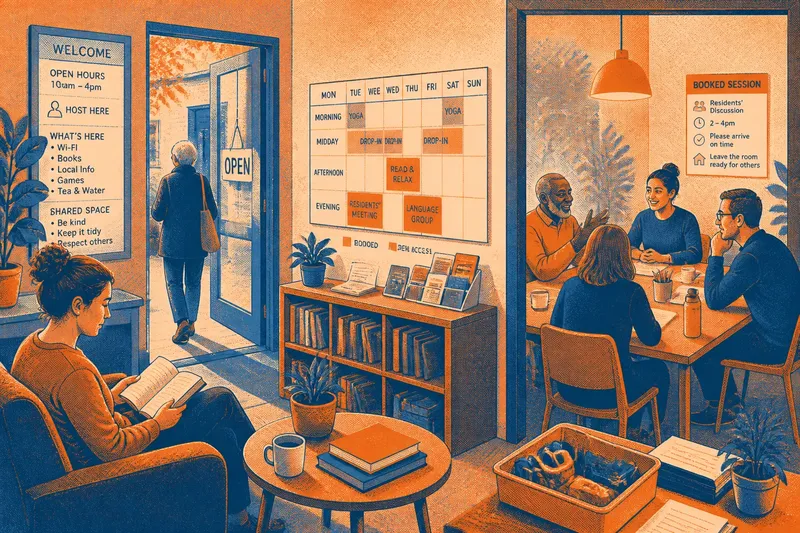
For drop-in hours to feel dependable, the basics should be visible at the entrance: when the room is open, whether a host is present, what equipment is available and which areas are shared. A sign that says “open” without any indication of what visitors can do leaves too much guesswork. A welcome note can explain whether people should sign in, where coats go, and how to leave the room ready for the next person.
Open hours also need a light-touch way of handling competing needs. A room may have a quiet corner and a conversation table, or a posted request to keep one walkway clear. These small cues help different users coexist without turning an informal visit into a formal meeting. If the room becomes too crowded or noisy for its intended uses, the response might be to adjust the open period or dedicate some of it to a quieter activity.
Say a neighbourhood room is usually empty on Thursday afternoons, and a few residents want somewhere to read, draw or talk informally. They could try a recurring drop-in window with a host, a sign explaining the room’s shared-use expectations and basic supplies in a labelled tray. The expected observable result is whether visitors can enter and choose an activity without waiting for a full group to assemble, and whether the space is still orderly when they leave.
Reserve slots when an activity needs a shared start
Booked sessions suit activities that depend on people arriving together, a facilitator being present or materials being set out in advance. Examples include a residents’ discussion, a sewing circle, a children’s craft session or a local planning workshop. A reserved time gives participants a clear commitment and helps the organiser prepare without occupying the room all day.
It also makes limits easier to communicate. The booking can state the session’s start and finish, who is responsible for opening and closing, what furniture may be moved, and how the room should be left. Those details matter when a later group needs the same tables or when the space is shared with people who are not attending the session.
Regular bookings can become difficult if they take up every convenient period. The room may appear active on a calendar while remaining unavailable to people who do not belong to its established groups. A fair arrangement can set a review date, invite requests from new users and keep some periods free for informal access. The point is not to make every group compete constantly, but to prevent a routine reservation from becoming an unspoken claim on the room.
Scheduled sessions also ask more of participants. People need to know the time, find the room and arrive when it begins. That structure may help a group focus, but it can exclude someone whose work, caring duties or transport make punctual attendance difficult. If arrivals are naturally staggered, consider whether the session can begin with an open activity before moving into the part that requires everyone’s attention.
Match the arrangement to the activity and its users
Compare the room’s likely uses along three practical lines: how predictable attendance must be, how much flexibility visitors need, and whether the activity requires preparation or a shared focus.
- Choose drop-in access when people can make use of the room independently and may arrive at different times.
- Choose a booked slot when a facilitator, group discussion or prepared equipment needs to be in place together.
- Consider a mixed pattern when the room serves both casual visits and organised sessions, and the boundary between them can be made clear.
- Reconsider the arrangement when people repeatedly arrive to find the room unavailable, or when reserved time is routinely unused.
These are starting points, not fixed categories. A board-game table might work as a drop-in activity if the games and rules are easy to understand, but a tournament with several rounds may need a booking. A small craft shelf might support casual use; a workshop involving a guest leader and specific materials may need a session time. Look at what actually must coincide rather than assuming that a named activity always calls for the same format.
When access, equipment or room use depends on the building’s rules, check the relevant instructions once with the person responsible for the venue. This is particularly useful when deciding who can open the room, where materials may be stored, or whether another use must be kept separate.
Make a weekly rhythm that people can learn
A workable routine combines a stable pattern with room to review it. At the start of a trial period, publish the open hours and confirmed bookings in one place inside the venue. Use plain language, and show which times are drop-in, which are reserved, and which are unavailable. A paper calendar near the entrance may be enough; a second channel can help people who do not visit regularly, provided the information stays consistent.
During the first week, have a named contact check that opening arrangements are clear and that any reserved group knows its responsibilities. This does not require someone to supervise every moment. It means visitors can tell what to do if the door is locked, the room is already in use or an item is missing.
In the following weeks, keep the published rhythm steady while noting practical friction. Are people unsure whether they can enter? Do booked groups need more time to set up or clear away? Are open hours too quiet to justify a host, or so busy that a second area would help? A brief note after each use can record the issue and a possible adjustment without collecting more personal information than the organisers need.
At the end of the trial period, ask users and neighbouring groups what they could reliably plan around. Keep questions concrete: could they tell when the room was available, could they take part in the activities they wanted, and did one pattern prevent another from using the space? Then make a small change to the timetable or room cues and state when it will be reviewed again.
How should neighbours choose between open hours and bookings?
Can a shared room offer both drop-in access and booked sessions?
Yes, if the timetable clearly separates the two and leaves enough time to reset the room between uses. A regular open period alongside selected reservations can support casual visits as well as activities that need a shared start.
What belongs in a drop-in room?
Choose materials people can understand and put away without a long explanation, such as books, drawing paper or clearly labelled local information. Keep anything that needs supervision, special preparation or exclusive use out of the casual-use area.
How can organisers tell that a booking is no longer useful?
Notice whether the session uses the reserved time consistently and whether anyone else is turned away because it occupies a scarce period. A conversation with the organiser may reveal that a shorter or less frequent booking would work better.
What if people arrive at different times for a scheduled activity?
Let the session begin with a flexible task or informal conversation, then move to the shared activity once late arrivals have had a fair chance to join. If staggered attendance is normal, a drop-in format may fit better than asking everyone to meet at one fixed moment.
Keep the timetable legible as the room changes
A community space is rarely serving only one kind of neighbour. Some people want a quiet place to sit; others need a table, a regular group or a reason to enter for the first time. Drop-in hours offer freedom to come when convenient, while booked slots make coordinated activity easier to prepare and attend. The better choice is the one that makes those needs visible rather than forcing them into a single pattern.
Keep the open room or booked slot arrangement easy to check at the door and easy to question when it no longer fits. A modest review of the weekly timetable can preserve reliable access without treating the calendar as permanent. In a shared space, the most useful schedule is one neighbours can understand, use and help revise.