What Local Announcements Leave Behind
Local announcements can become part of community memory. Learn what to preserve, how to record decisions and where future organisers can find useful context.
When a neighbourhood group clears out a cupboard, it may find a folded flyer for a gathering whose organisers have moved away. Local announcements are more than invitations: kept with care, they can show how a shared place was used and who helped shape it. The useful question is what to preserve once the immediate event has passed.
Local announcements can become community memory
A flyer, a noticeboard photograph or a message saved by its author can help future neighbours understand what happened in a shared space. These traces rarely tell the whole story. They are fragments: a date, a venue, a group name, perhaps a handwritten change. Their value lies in giving people something concrete to ask about and build on.
Not every announcement deserves permanent storage. Keep material that records a change in how a place was used, a gathering that became recurring, a local collaboration or a decision that shaped later activity. A routine reminder may be less useful unless it captures a detail that would otherwise disappear.
Think of an archive like a labelled kitchen drawer: it works when a person can find the thing they need without knowing who put it away. A handful of carefully described records is often more useful than a box of unlabelled paper.
Preserve the context, not just the notice
A saved announcement can become confusing when it lacks the circumstances around it. Add a short note identifying the place, the organising group if known, and why the item was kept. Record whether it was a draft, a final version or a correction; otherwise, a later reader may mistake an abandoned plan for something that took place.
For a digital message, preserve the relevant text in a form that can be opened outside the original chat, and note where it came from. Avoid copying an entire conversation when only a few lines matter. Remove personal details that are not needed for the record, and ask permission before preserving or sharing sensitive contributions.
- Check whether the item shows a lasting change or recurring activity; if it does, retain it with context, and if it is only a routine reminder, discard it unless it fills a clear gap.
- Check whether the notice is a draft, final version or correction; if that is clear, label it accordingly, and if not, mark its status as unknown rather than presenting it as settled.
- Check whether names or contact details are needed for future understanding; if they are essential and permission is clear, preserve only what is needed, and if not, redact them or omit the item.
- Check whether the file opens in a common format; if it does, keep a copy with its source note, and if it does not, export or transcribe the relevant content into an accessible format.
- Check whether the record identifies its date and location; if both are known, add them to the description, and if either is uncertain, state that uncertainty rather than guessing.
- Check whether another copy already exists; if a clearer, complete version is available, keep that one and note the duplicate, and if not, preserve the best available copy.
Give records a simple, findable home
A community hall might keep a paper folder for printed material and a shared digital folder for scans and notes. The exact system matters less than having a known custodian, a clear naming method and an agreed way for future organisers to request access. Use descriptive file names, such as a place and event name, rather than labels like “old flyer”.
Separate public material from records containing private details. A public-facing folder can hold a flyer or a short account of an event, while sensitive correspondence stays out of it unless there is a clear reason and permission to retain it. If the group is unsure about privacy or retention duties, seek advice from an appropriate professional or organisation.
How should a group decide what to keep?
Should every event flyer be archived?
No. Keep a flyer when it documents a meaningful change, a recurring gathering or a collaboration that future organisers may need to understand. If it is routine and adds no context, a brief record may be enough—or nothing may need preserving.
What should a note beside an announcement say?
Record the known date, place, source and status, plus a sentence explaining why the item matters. Mark gaps plainly; an uncertain date is more honest and useful than a confident guess.
Can a group save messages from a private chat?
Do not treat access to a conversation as permission to publish or preserve everything in it. Ask before retaining identifiable contributions, keep only what serves a clear community-memory purpose and remove details that are not needed.
How can future organisers find the records?
Choose a stable shared location, name a person or group responsible for it, and tell incoming organisers where the material lives. A short index of folders and file names can prevent useful records from becoming effectively lost.
A worked example shows what a useful record contains
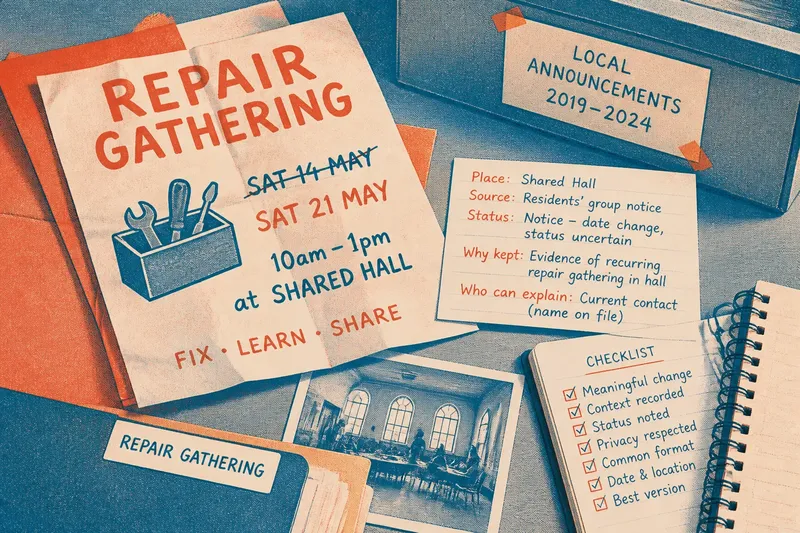
Imagine a residents’ group has a paper notice announcing a monthly repair gathering in a shared hall. The notice has a handwritten date change, but it does not say whether the change was final. A volunteer scans the sheet, labels the file “Shared hall repair gathering—notice, status uncertain”, and adds a note that identifies the hall, the source and the visible correction without claiming the gathering went ahead.
The volunteer then checks with the group’s current contact, who confirms that the gathering became regular but cannot establish which date the first meeting took place. The record is updated to say that the activity recurred and that the first date remains unknown; names and private contact details are left out. A future organiser can now find evidence of the gathering and its location without inheriting an unsupported date or unnecessary personal information.
Leave a record that invites the next question
Good community memory does not turn every scrap of paper into an official account. It preserves enough context for a future neighbour to distinguish a proposal from a decision, a one-off event from a recurring practice, and a known fact from an uncertain detail. That is the lasting use of local announcements: not only telling people what to do next, but helping them understand what came before.
For local announcements worth keeping, add one final line to the record: who can explain it, if anyone is known. When that person is no longer available, the note still gives the next organiser a clear starting point rather than leaving them to interpret the paper alone.