The All-Hands Meeting Is Not the Only Way to Involve People
Involve people without an all-hands meeting by bringing different contributions into one clear record, so neighbours can see how their views shape a decision.
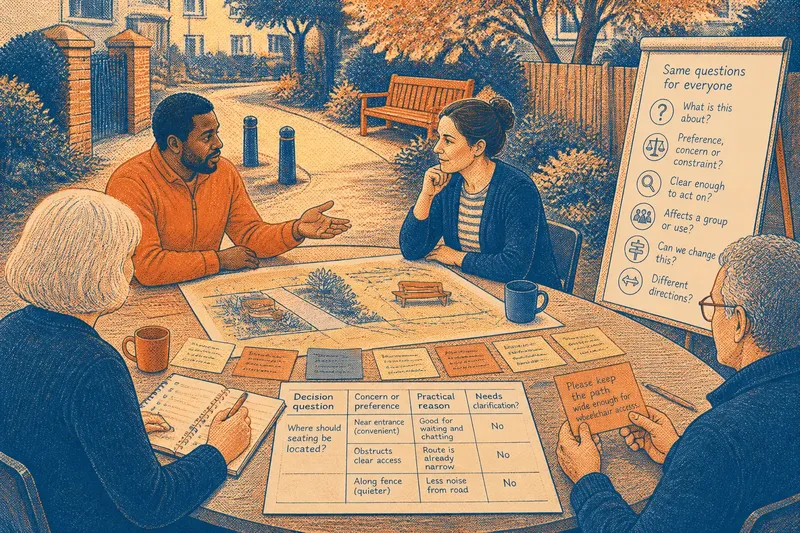
A neighbour sends a note about the garden path, another raises a concern during a quick conversation, and a third speaks at the residents’ meeting. To involve people without an all-hands meeting, the group needs more than several ways to speak: it needs a fair method for weighing what those contributions actually say.
Different formats can reveal different concerns, but the number of comments in one format does not tell organisers which view matters most. The useful work is to understand the issue each person is raising, distinguish preferences from practical constraints, and make the basis of the decision visible.
Separate the issue from the route it arrived by
A written response and a spoken comment are not competing categories of evidence. They are contributions made in different circumstances. Someone may prefer a private note for a sensitive concern, while a face-to-face conversation can make it easier to clarify an ambiguous point.
Record each contribution against the question it addresses, not under a heading such as “meeting comments” or “online responses”. A simple table can include the decision question, the concern or preference, any practical reason given, and whether the point needs clarification. Keep identifying details out of the working summary unless they are necessary.
This distinction prevents a familiar error: treating a repeated preference as a complete account of the problem. Several neighbours may favour benches, for example, while one person explains that a proposed position would obstruct access. Those points are not equivalent votes; they describe a preference and a constraint that may need to be considered together.
Use the same questions to compare different contributions
Before responses arrive, decide how the group will examine them. A small set of consistent questions helps organisers avoid giving extra weight to comments simply because they were easy to hear or count:
- What is the person responding to? If the comment addresses the decision being made, include it in the relevant discussion; if it concerns another issue, record it separately and explain where it belongs.
- Is this a preference, a concern or a practical constraint? If it is a preference, compare it with other stated preferences; if it identifies a possible obstacle, check that obstacle before treating it as a matter of taste.
- Is the meaning clear enough to act on? If the comment is unclear and contact is appropriate, ask a focused follow-up; if no clarification is possible, record the uncertainty rather than guessing.
- Does the point affect a particular group or use of the space? If it identifies an access or timing concern, consider that context directly; if it does not, assess it alongside the other concerns without assuming it applies to everyone.
- Can the group change the matter raised? If it remains open to decision, weigh it against the agreed criteria; if it is already fixed or outside the group’s authority, state that limit and identify any useful next route.
- Do contributions point in different directions? If they do, describe the competing interests and consider whether a revised option addresses both; if they do not, proceed while noting any important qualification.
These questions are not a scoring system. They make the group’s reasoning easier to examine and help prevent a confident speaker or a neatly completed form from dominating by default.
Keep disagreement visible without turning it into a tally
A count can describe how many responses expressed a particular preference, but it cannot by itself explain why people hold it or whether a less common concern changes what is workable. Treat counts as one piece of context, not as a substitute for considering the substance.
When views conflict, name the difference in plain language. “Some neighbours want seating near the entrance; others worry that this would narrow the route” is more useful than saying the feedback was mixed. The first account gives the group a question it can examine.
Then check whether the disagreement is about the goal, the proposed arrangement or a consequence. A revised option may resolve a practical conflict; if it cannot, the group should say which considerations it gave priority and who had authority to decide. Do not present a compromise as unanimous if people still disagree.
Write down the reasoning while it is still clear
A shared record need not be elaborate. It should let organisers trace the path from contributions to decision without exposing private details. Note the main themes, relevant constraints, points still disputed, and the reason for the choice. If an issue was outside the group’s control, make that boundary plain.
For example, say the group is choosing between a seating area beside a shared garden entrance and one farther along the fence. It receives a spoken preference for the entrance, a written concern that a bench there could obstruct the route, and a note favouring the fence because it is quieter. Organisers map both locations, check how each affects passage, and ask neighbours to comment on the revised options. If the entrance location leaves too little clear access, they can choose the fence location and record both the access concern and the quieter setting as reasons; if neither option addresses the concern, they can pause the choice and seek a different layout. The example shows how each contribution can inform a decision without being treated as a vote for or against the whole plan.
Share a short account of the outcome in the places where the question was raised. Explain which concerns shaped the choice, which could not be accommodated and why. If contact details or sensitive personal information are involved, handle them according to local requirements and seek qualified advice where needed.
What should organisers do when contributions conflict?
Should every comment carry the same weight?
Every relevant comment deserves consideration, but different comments may describe different kinds of information. A preference, an access concern and a practical limit should be assessed according to what each contributes to the decision, rather than assigned an arbitrary equal score.
What if only a few people raise a concern?
Do not dismiss a concern simply because it appears rarely. Check whether it points to a practical consequence or affects a particular use of the space; if the group cannot verify it, record the uncertainty and explain how it affected the choice.
How can organisers handle unclear feedback?
Ask a brief, neutral follow-up when it is appropriate and possible, such as which part of the proposed arrangement causes concern. If clarification is unavailable, keep the original meaning uncertain rather than filling in the gaps yourself.
What should be shared after the decision?
Share the decision, the main considerations and any unresolved disagreement. Say how contributions influenced the outcome, and distinguish that influence from a claim that everyone supported the result.
Make the reasoning as accessible as the invitation
To involve people without an all-hands meeting, treat every route as a way into one consistent decision process, then report how the substance of contributions was considered. A short written summary, a marked-up plan or a verbal update at a familiar local gathering can make that reasoning easier to follow.
The final account should leave room for a neighbour to recognise their concern, even if the group did not choose their preferred option. That small act of precision makes the next disagreement easier to discuss on its merits rather than on suspicion about how the decision was reached.